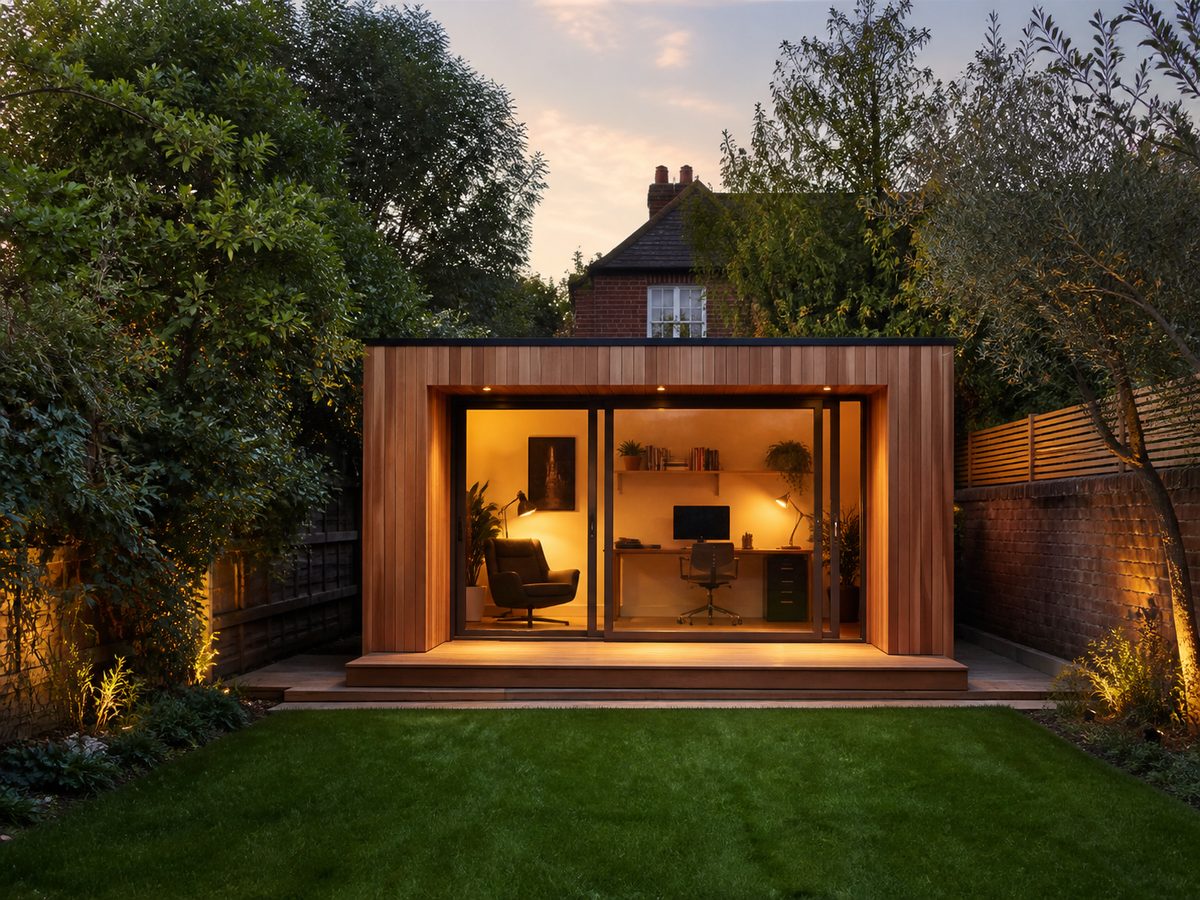
A professionally built, insulated garden room for year-round use costs £15,000–£35,000 in the UK in 2026. By size: small rooms (4.5–7.5m²) run £12,000–£25,000, medium (9–15m²) £16,000–£38,000, large (18–24m²) £26,000–£50,000 (MyJobQuote). Entry-level flat-packs start near £9,000 but exclude foundations, installation and often VAT. Groundworks add £500–£2,000 in every case.
How much does a garden room cost by size?
Size drives garden room cost more than anything except plumbing. The per-m² rate falls as rooms grow, because groundworks and delivery are near-fixed costs.
| Size | Typical installed cost (2026) | Use case |
|---|---|---|
| Small (4.5–7.5m²) | £12,000 – £25,000 | Single home office or studio |
| Medium (9–15m²) | £16,000 – £38,000 | Office with seating/gym zone |
| Large (18–24m²) | £26,000 – £50,000 | Office + gym split, or annexe-ready shell |
Per square metre, garden rooms run £1,200–£2,200/m² turnkey — competitive with house extensions (£1,800–£3,300/m²) and cheaper than any structural build, because there are no foundations under the house, no party walls and no roof integration.
What does a garden room cost by quality tier?
The market splits into three honest tiers, and knowing them stops you overpaying:
| Tier | Cost (2026) | What you get |
|---|---|---|
| Entry-level | £9,000 – £15,000 | Flat-pack or small modular. Self-assembly or delivered shell. Often excludes foundations, electrics and VAT — check quotes line by line. |
| Mid-range | £16,000 – £30,000 | Turnkey, fully insulated, double glazing, laminate floor, electrics included. Eurocell starts at £8,499; Green Retreats B-range from £9,485. |
| High-end | £30,000 – £50,000+ | Aluminium bi-folds, premium cladding, heating/AC, plumbing for toilet/shower. Green Retreats X1 range from £49,950. |
2026 shopping-pack reality check from live listings: Quick Garden rooms span £2,434–£43,535, Dunster House's Dominator garden office sits at £12,567, Tiger modular at £25,537, and Wickes' Forest Xtend insulated offices at £9,124–£12,799. The spread is the specification, not the square metres.
Garden Room Cost Calculator
Size, tier and extras for a 2026 estimate.
How much does a garden room with toilet and shower cost?
A garden room with toilet and shower costs £25,000–£45,000 — £8,000–£15,000 above the same room electrics-only. The jump is drainage, not the fittings: connecting to the mains drain (£1,500–£4,000 depending on distance), a macerator unit or gravity soil run, inspection chambers, and building regulations sign-off for sanitation (Part H) and ventilation. A toilet-only compromise costs £5,000–£8,000 less than full wet-room plumbing and still transforms the room's usability as a full-day office.
What extra costs come with a garden room?
| Extra | Typical cost (2026) |
|---|---|
| Groundworks — concrete base or ground screws | £500 – £2,000 |
| Electrical trenching + armoured cable from house | £500 – £1,500 |
| Water/data trenching | £300 – £1,000 |
| Toilet + shower plumbing (if added) | £8,000 – £15,000 |
| Heating — panel heater to air-con heat pump | £200 – £2,500 |
| VAT — kits often quote ex-VAT | +20% where excluded |
Site access moves the groundworks line hardest: a sloped garden or no digger access turns a £700 base into a £2,500 engineered solution.
Is it cheaper to build a garden room or buy one?
Buying wins at the bottom of the market and building wins only in the middle — and rarely by as much as YouTube suggests. A £9,000 flat-pack kit plus £2,000–£3,000 of trades (base, electrics, insulation) totals £11,000–£13,000 against £15,000+ turnkey: real savings, if you assemble it yourself. A DIY 12m² insulated build costs £10,000–£18,000 in materials alone (timber frame, insulation, EPDM roof, glazing, cladding, electrics) plus 100–150 labour hours, against £16,000–£30,000 turnkey — and the turnkey route carries a warranty and passes wind-loading checks. The honest break-even: DIY only pays on basic small rooms or if you already own the tools and the skills.
Do I need permission for a garden room?
Most garden rooms are permitted development as outbuildings (Planning Portal rules):
- Single-storey only
- Max 2.5m height within 2m of any boundary; eaves 2.5m and ridge 4m (dual-pitch) or 3m (mono-pitch) elsewhere
- Room + all other outbuildings cover no more than 50% of the garden
- Not forward of the front elevation of the house
- Use stays incidental to the house — office, gym, studio
Permission IS required for listed buildings, conservation areas, and any design breaking the limits. Two traps: business use (client visits, employees) can break "incidental" status, and sleeping accommodation does — see the next section. Ground screws avoid the concrete pour and often simplify permitted development compliance on sloped sites.
Can I legally sleep in a garden room?
Occasionally, in practice, without anyone noticing — but legally, full-time sleeping changes the building's classification. A room used as residential accommodation stops being "incidental to the house", requiring planning permission for change of use plus building regulations sign-off for fire escape, ventilation and thermal standards. Councils increasingly challenge garden rooms advertised as guest annexes on planning portals and via aerial imagery. If you need genuine sleeping accommodation, budget for permission and Part B compliance from the start — or use the room as a guest space with a sofa bed and keep it legal.
Do garden rooms add value to a house?
A quality insulated garden room adds roughly 5–8% to property value — real, but a fraction of the ~20% a loft conversion adds, because valuers do not count garden rooms as habitable floor space. The value case concentrates in one use: the garden office. Post-2020, dedicated home-working space is a filter buyers apply, and a wired, heated, insulated room reads as usable square metres even if the EPC ignores them. An uninsulated summerhouse adds nothing to value — it is a shed with branding.
How long does a garden room take to install?
| Route | Typical duration |
|---|---|
| Turnkey modular (mid-range) | 3–5 days on site |
| Flat-pack kit, self-assembly | 2–4 weekends + trades |
| Bespoke timber-frame build | 3–6 weeks |
| With plumbing + permission | 8–12 weeks all-in |
Turnkey is the quiet revolution of this market: manufacturers crane a factory-built room onto prepared groundworks in under a week, insulation and electrics included. No other renovation in this guide completes inside a week.
Frequently asked questions
How much does a garden room cost in the UK?
£15,000–£35,000 year-round turnkey; £12k–£50k across sizes. Entry kits from ~£9,000 excluding foundations and often VAT.
Do I need permission for a garden room?
Usually not — permitted development if single-storey, ≤2.5m within 2m of a boundary, under 50% garden coverage, and incidental use. Listed buildings and conservation areas need permission.
Is it cheaper to build a garden room or buy one?
Kits win small and basic (£11k–£13k all-in). Mid-size DIY barely beats turnkey once materials and 100+ hours are counted. Turnkey carries the warranty.
Do garden rooms add value to a house?
5–8% for a quality insulated room — real but not habitable floor space. Strongest where it works as a garden office.
Can I legally sleep in a garden room?
Full-time sleeping breaks "incidental use" and needs planning permission plus Part B sign-off. Guest sofa-bed use sits in a grey zone councils increasingly challenge.
How much does a garden room cost per m²?
£1,200–£2,200/m² turnkey. Groundworks (£500–£2,000) are fixed, so small rooms cost more per m².
How much does a garden room with toilet and shower cost?
£25,000–£45,000 — drainage (£1,500–£4,000), macerator, and Part H sign-off add £8k–£15k over electrics-only. Toilet-only saves £5k–£8k.
What size garden room can I build without planning permission?
Any size subject to the cumulative rules: 2.5m height near boundaries, 50% garden coverage, single-storey. A 30m² room is fine on a big enough plot.
Ready for real quotes?
Tell us where to send them — we'll match your project with a vetted local specialist and email your free, no-obligation quotes.
No spam, no call centres — just your quotes.