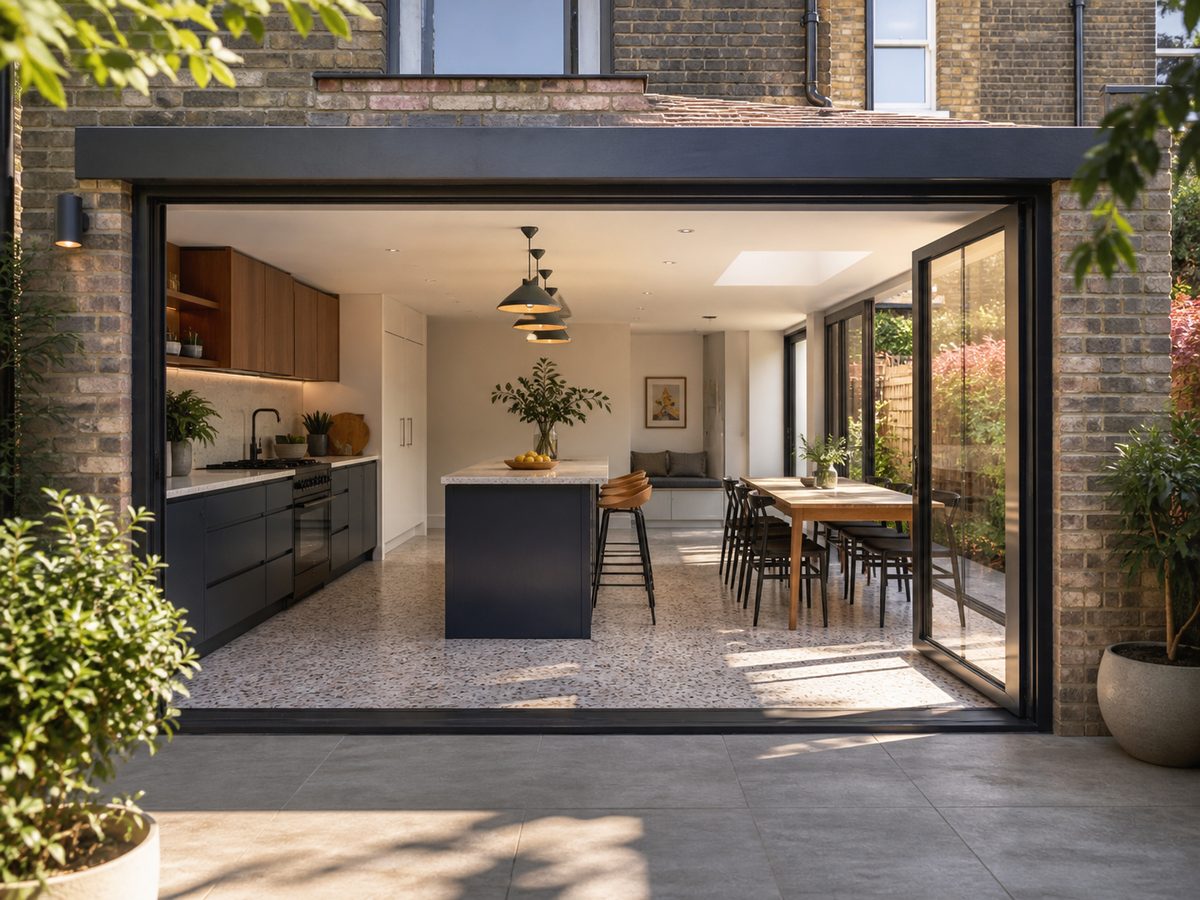
A side return extension costs £22,000–£55,000 in most of the UK in 2026, and £35,000–£90,000+ in London and the South East. A typical 2m × 6m side return (12m² of new floor) runs £21,600–£33,600 at mid-range spec outside London, £28,100–£43,700 in the capital. Add £9,500–£30,000 when the project includes a fitted kitchen. The single biggest variable is not size — it is whether your borough has removed permitted development rights.
What is a side return extension?
A side return extension fills in the narrow strip of land running along the side of a Victorian or Edwardian terraced house, typically 1.5–2.5m wide and 4–8m long. The result is a widened kitchen-diner: a 1.5m-wide galley kitchen becomes a 4m-wide open-plan room, gaining 6–20m² of floor space without touching the garden's main run. Side return extensions are almost always single storey with a flat roof and a run of rooflights or a glass lantern over the old side wall line.
How much does a side return extension cost by region?
Side return extension costs split sharply by region because the work is London-centric: most side returns are built on terraced houses, and London labour rates add 25% to every line.
| Region | Mid-range side return cost (2026) | What drives the price |
|---|---|---|
| UK (outside London) | £22,000 – £55,000 | Standard labour rates, simpler access, fewer party wall issues on wider plots |
| London & South East | £35,000 – £90,000+ | +25% labour and materials, Article 4 planning, restricted access, party wall on both sides |
| London basic shell (up to 15m²) | £35,000 – £54,000 inc VAT | Structure, foundations, flat roof — kitchen excluded (LCCL Construction, 2026) |
| London high spec (25m²+) | £72,000 – £90,000+ inc VAT | Bespoke joinery, large-format glazing, underfloor heating, integrated kitchen |
Side Return Extension Cost Calculator
Set your side return's width and run length for a realistic 2026 range.
How much does a side return kitchen extension cost?
A side return kitchen extension costs £30,000–£75,000 all-in: the build (£22,000–£55,000 outside London, £35,000–£90,000+ in London) plus the fitted kitchen at £9,500–£30,000. The kitchen is usually the largest single line after the structural work, which is why two identical side return builds can differ by £20,000 in final spend. Budget the kitchen separately from the builder's quote — most builders fit the kitchen the supplier delivers, and quote only the fitting labour.
| Kitchen line | Typical cost (2026) |
|---|---|
| Fitted kitchen units (mid-range) | £5,000 – £12,000 |
| Worktops (laminate to engineered stone) | £1,000 – £4,000 |
| Appliances (oven, hob, dishwasher, fridge) | £2,000 – £8,000 |
| Installation and fitting labour | £1,500 – £6,000 |
What does a glass side return extension cost?
A glass side return extension adds £2,500–£12,000 to the build, depending on how far you take the glazing. A run of three fixed rooflights over the infill costs £2,500–£5,000 supplied and installed; a structural glass lantern runs £5,000–£9,000; full-width sliding or bifold doors onto the garden add £3,000–£12,000. Glass is not optional in practice — the infill sits against the neighbouring wall, so the roof is the only daylight source for the old kitchen section, and building regulations Part L requires a fixed-ventilation strategy for the new space.
Do I need planning permission for a side return extension in the UK?
Most London side return extensions need full planning permission. Many London boroughs (Islington, Kensington & Chelsea, Camden, Wandsworth and others) have Article 4 directions that remove permitted development rights on terraced streets, which forces a householder application (£258, England, 2026). Where permitted development survives, a side extension must be single storey, max 4m high, and no wider than half the original house — a full side return to the boundary usually fails that test and needs permission anyway. Listed buildings and conservation areas always need permission. Assume a 8–13 week decision window and budget for a party wall notice to both neighbours (2 months before work starts).
Is a side return extension worth it?
A side return extension is worth it on a Victorian or Edwardian terrace where the alternative is a 1.5m-wide dead strip down the side of the house. The build converts that strip into the widest room in the house, and terraced houses sell on kitchen-diner space: a good side return kitchen is the feature estate agents lead with. The maths test is the same as any extension — worth it when the build (£22,000–£90,000) costs less than the value it adds and less than 25% of the property. Not worth it when the remaining garden drops below 5m usable width, or when the house's layout pushes the new space into a dark corridor.
What is the most expensive part of a side return extension?
Steelwork and groundworks are the most expensive part of a side return extension. The steel beam or goalpost frame over the widened kitchen opening runs £1,500–£4,000 installed; foundations for the new wall line run £3,000–£8,000; the flat roof adds £4,000–£9,000. Together they account for 40–50% of the build cost. A structural engineer must design the steelwork (calculations cost £600–£1,200) because the old side wall becomes a beam bearing on both party walls.
What extra costs come with a side return extension?
Side return projects carry more statutory cost than a rear extension on the same house, because both sides are usually party walls.
| Extra cost | Typical fee (2026) |
|---|---|
| Architect drawings (London side returns rarely standard) | £2,500 – £6,000 |
| Structural engineer (steel design over the opening) | £600 – £1,200 |
| Planning application (Article 4 boroughs) | £258 householder (England) |
| Building control | £500 – £1,000 |
| Party wall surveyor (two neighbours, typical) | £700 – £1,500 each |
| Build-over agreement (Thames Water / drains) | £350 – £600 |
| VAT (20%) — usually excluded from builder quotes | +20% on labour and materials |
How long does a side return extension take?
A side return extension takes 10–14 weeks on site, a week or two faster than a wider rear build because the footprint is small and the roof is a simple flat. The paperwork before it takes longer: 4–8 weeks of design and structural drawings, 8–13 weeks for planning where Article 4 applies, and a 2-month party wall notice period that can run in parallel with planning. Full project: 5–7 months from first sketch to finished kitchen.
Side return or rear extension — which costs less?
A side return costs less than a rear extension of the same length because it is narrower: a 2m × 6m side return creates 12m² for £21,600–£43,700, while a 4m × 6m rear extension creates 24m² for £43,200–£87,400. Per square metre they price the same — the choice is about where your house is tightest. Many terrace owners run both at once as a wraparound, which costs £60,000–£100,000+ in London and gains a full open-plan ground floor. For the full cost picture across sizes and storeys, see the house extension cost guide.
Frequently asked questions
Is it worth doing a side return extension?
Yes on a Victorian or Edwardian terrace with a narrow dead strip — it creates the widest room in the house. Not worth it if the garden drops below 5m usable width or the build exceeds 25% of property value.
Do I need planning permission for a side return extension in the UK?
Usually yes in London — Article 4 directions remove permitted development on many terraced streets. Elsewhere a single-storey side extension under 4m and half the house's width can be permitted development. Application fee: £258 (England, 2026).
How much does a side return kitchen extension cost?
£30,000–£75,000 all-in: £22,000–£55,000 build outside London (£35,000–£90,000+ in London) plus £9,500–£30,000 for the fitted kitchen.
Is 50k enough for an extension?
Yes for a mid-range side return with kitchen outside London. In London, £50,000 covers the structural build only — shells run £35,000–£54,000 inc VAT.
What is the most expensive part of a house extension?
Steelwork and groundworks: £4,500–£12,000 combined, 40–50% of the build cost. The kitchen overtakes them only on high-spec projects.
How long does a side return extension take?
10–14 weeks on site; 5–7 months total with design, planning and party wall notices.
How we researched these prices
Every range on this page is cross-checked across three kinds of source, last compared on 18 October 2026:
- Published 2026 price guides — LCCL Construction's London side return pricing, MyBuilder and Checkatrade extension cost guides, Beams Renovation and Architecture for London side return guides. Where guides disagree we quote the overlapping band, not the outlier.
- Real builder quote structures — side return quotes itemise steelwork, foundations, flat roof, rooflights and kitchen fitting separately; we price each line from published 2026 rates, including what quotes exclude (VAT, fees, kitchen supply).
- Live search data — we re-check current published ranges for side return terms monthly, so the figures reflect what builders are quoting now, not last year's averages.
The ranges assume a typical project — a 1.5–2.5m wide, 4–8m long infill on a Victorian or Edwardian terrace. Basements, piled foundations or full-width structural glazing push towards the top of each band.
Prices last checked: 18 October 2026 · Page published: 18 October 2026
Ready for real quotes?
Tell us where to send them — we'll match your project with a vetted local specialist and email your free, no-obligation quotes.
No spam, no call centres — just your quotes.